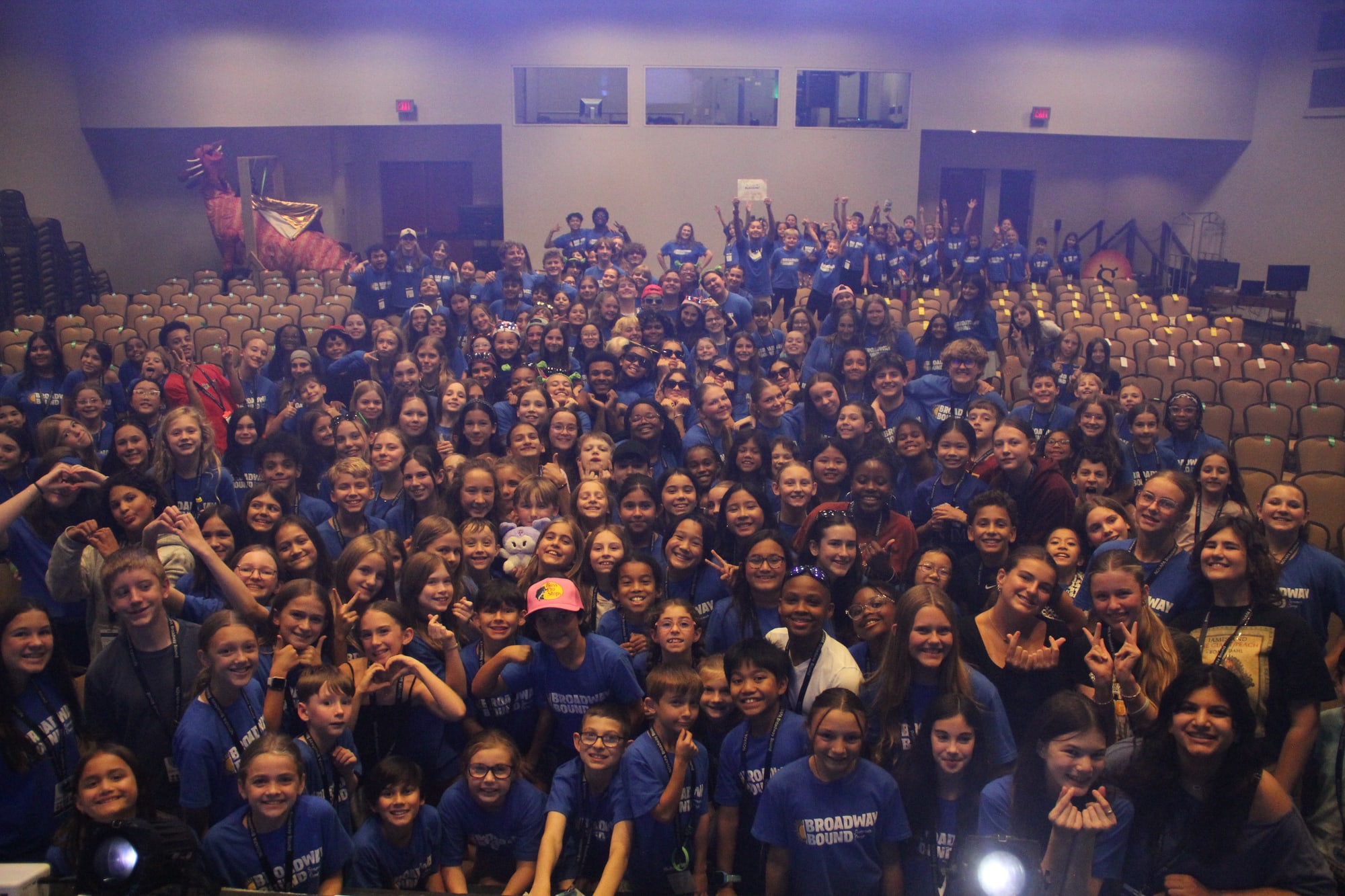
Every camp session, there is a child who arrives on the first Monday and will not take the hoodie off. Hood up, arms crossed, standing near the door of the rehearsal room the way you stand near the exit of a party you did not want to attend. Their parent lingers in the doorway with a look I have seen a thousand times in twenty years of this work. The look says: was this a mistake?
Twelve days later, that same child bows.
Not in the back row. Somewhere in a full company number, in costume, under real lights, in front of a real audience, in a complete Junior-edition musical the cast built in fourteen days. And the parent who lingered in the doorway is now the one standing up first at the curtain call. I have watched that exact arc so many summers in a row that I no longer call it a surprise. I call it the design.
So let's talk honestly about summer theatre camps in Northern Virginia, because if you are searching for one right now, you are probably asking three questions nobody in this region likes to answer plainly: what does it actually cost, what should my child actually get for that money, and how do I tell a real theatre camp from expensive babysitting with a "showcase" stapled to the end.
How Much Do Summer Theatre Camps Cost in Northern Virginia?
Here is a strange habit of our industry. Search "theatre camp Fairfax," "theatre camp Ashburn," "musical theatre summer camp Northern Virginia," and you will find beautiful websites, glowing testimonials, and almost no prices. You are invited to inquire. To join a mailing list. To request a quote, as if a two-week drama camp for a nine-year-old were a kitchen renovation.
Let me be clear: you deserve the numbers.
So here is how the Northern Virginia market actually breaks down, from someone who has priced programs in it for years. Half-day hobby camps, a week of games and a short showcase, generally sit at the low end. Full-day, multi-week production camps, where children rehearse and open a complete licensed musical with professional staff, sit at the top, and nationally those routinely run four figures. Day-camp math is different again: single-day theatre camps on school holidays are priced per day, not per session.
Since I believe prices belong in public, here is a real data point: our own two-week production camp is $995 per performer, Monday through Friday, 8:30 AM to 4:15 PM, roughly seventy hours of rehearsal and production work ending in public performances. I share that not as a pitch but as a benchmark. Whatever camp you are comparing, ask what the fee buys in hours on task and in what your child opens on the final weekend. A price without those two facts is not information yet.
The Fourteen-Day Arc: What a Real Production Camp Looks Like
A real theatre camp is not activities. It is a production schedule scaled to a young company. At our camps, held at the National Conference Center in Leesburg, the two weeks run like this:
- Days one and two | Belonging before performing. Names, games, ensemble work, and auditions that feel like play. Every child is cast. Every child. That is a non-negotiable.
- Days three through seven | Music, choreography, and staging, block by block, scene by scene. This is where the hoodie starts coming off.
- Days eight through eleven | Runs, fixes, costumes, and the first time the company hears itself sound like a company.
- Days twelve through fourteen | Tech, dress, and performances for a real audience.
For Summer 2027 the shows are How to Train Your Dragon JR. (July 5–16), Roald Dahl's Charlie and the Chocolate Factory JR. (July 19–30), and Trolls The Musical JR. (August 2–13), with casts grouped by age: 5–9, 9–12, and 12–15. Grouping matters more than parents expect. A seven-year-old and a fourteen-year-old are not doing the same work, and a camp that mixes them into one giant clump is telling you something about its priorities.
Real Camp or Expensive Babysitting: Five Questions That Sort It Out
I have directed more than a hundred productions, and I am here to tell you the difference between a production camp and a drop-off program is visible from five questions:
- Is every child cast in a real role in a real show? Not a "showcase of songs." A licensed, complete musical with a beginning, middle, and bow.
- Who is in the room? Working theatre professionals, background checked, or seasonal counselors? Ask. A serious program is proud to answer. Ours is on our faculty page.
- Is the price published? You now know how I feel about this one.
- How are nervous first-timers handled? The answer you want involves the first two days, not a shrug. My graduate training is in theatre education and drama therapy, and our staff learn how to talk to a scared nine-year-old before they learn blocking.
- What happens on the last day? If the answer is "parents can peek in at pickup," keep looking. Children rise to real audiences. They deserve one.

If a camp fails two of the five, it is childcare in a costume.
And listen, childcare is honorable work. Plenty of families need exactly that, and there are cheaper ways to get it. But if your child is the one singing into a hairbrush, staging living-room premieres, narrating the dog's inner life at dinner, then a real production camp is not a luxury version of the same thing. It is a different thing.
Day Camps, Half-Day Camps, and Production Camps: Know Which One You're Buying
Parents searching "performing arts camp near me" are usually comparing three different products without knowing it:
- Single-day theatre camps | One school holiday, one day of drama games and scene work. Excellent for testing the waters with a curious child, and for teacher-workday childcare that actually feeds the child's interest.
- Half-day or one-week hobby camps | Mornings of games, crafts, and songs, sometimes a Friday showcase. Real value for younger children who mostly need play with a theatrical flavor.
- Full production camps | Multi-week, full-day, a licensed musical rehearsed and performed for the public. This is the one that changes a child, and the one worth real comparison shopping.
None of these is a scam and none is wrong. The mistake is paying production-camp prices for a hobby camp, or expecting a production-camp transformation from three mornings of theatre games.

When Do Northern Virginia Summer Camps Fill Up?
Earlier than almost every family expects. The regional camp roundups and camp fairs now happen in February. Established programs, in theatre and everything else, fill their most popular age bands months before school lets out, and the middle band, roughly ages 9 to 12, is consistently the first to go regionwide. Every spring I answer some version of the same email: we just heard about your camp, is there any room left in July? Some summers the answer is yes. Some summers it is the sentence no director enjoys saying to an eight-year-old's mother.
Put simply: the families with the most choices are the ones comparing camps in fall and winter, not May. If you are reading this in September, you are early, which is exactly where you want to be.
Closing Reflection: The Hoodie Comes Off
My students call me Mr. CJ. Parents usually start with Mr. Cimino-Johnson and land on Mr. CJ by the second Friday, at pickup, somewhere between the flowers and the crying. That second Friday is the whole argument for this kind of camp, and it has nothing to do with launching a Broadway career at age nine.
A child who builds a show in fourteen days learns that big scary things become doable when a room full of people does them together, one rehearsal at a time. They learn their voice carries. They learn the ensemble needs them, specifically, in row two of the dragon dance, or the whole picture is wrong.
They will not remember every lyric by Christmas.
They will remember that the hoodie came off.
They will remember that they were seen.
Whichever camp you choose, in Leesburg or Ashburn or Fairfax or anywhere in this region, choose the one that understands that is the actual product. Everything else is scenery.