She sat in her car in the parking lot for eleven minutes.
I know it was eleven because I could see the lot from the studio window, and I was watching the way you watch a first-night student who has emailed three times to ask whether it is really okay if she has never done this before. She was forty-seven. She had, she told me later, rehearsed walking through the door.
She came in with four minutes to spare, took the chair nearest the exit, and did not say a word during introductions except her name.
Ninety minutes later she was standing in the middle of the room, arms out, telling a total stranger that he had absolutely, without question, stolen her parking space, and the stranger was insisting with his whole body that the space had been his since 1994, and the room was laughing so hard that I had to call time. She drove home. She emailed me from the driveway. The email said: "I forgot I could do that."
That sentence is what an adult acting class is for.
Who actually takes adult acting classes (and why it is almost never to become an actor)
Search "adult acting classes for beginners" and nearly every result assumes you want a career. The articles are written by studios in New York and Los Angeles and by trade magazines, and they answer a question you probably did not ask: how do I break in, how do I get an agent, is forty too old to book work.
Let me be clear about who actually walks through the door on a Tuesday night. A nurse who has not been in a room where she was allowed to be silly since college. A federal contractor who presents to two hundred people and has never once felt present doing it. A man going through a divorce who read somewhere that improv helps. A woman who did theatre in high school thirty years ago and has thought about it every year since.
In twenty years of teaching adults, I can count the students who wanted a professional acting career on one hand. Everybody else came for the same reason the woman in the parking lot came. They wanted to remember they could do that.
So this is not an article about launching a career. It is about what a beginner adult acting class actually is, what happens in the room, and how to pick one that will not waste your Tuesday nights.
Am I too old to start acting classes? The honest answer
No. And the question is worth taking apart, because it is doing something sneaky.
"Too old" is a question about a career ladder. It assumes there is a window, and the window is closing, and past a certain age the effort is wasted. That framing comes from the professional side of the industry, where it is at least partly true. It has nothing to do with a class.
In the beginner adult classes I have taught, the median student is somewhere between thirty-five and fifty-five. The oldest student I have had was seventy-one. She was, and I say this without sentiment, the best listener in the room, because she had stopped caring what anyone thought of her about fifteen years earlier and had nothing left to protect. The twenty-four-year-olds in that class learned more from watching her than from anything I said.
Put simply: acting is the study of paying attention to another person and responding honestly. Adults are better at it than children. Older adults are often better at it than younger ones. You are not late. You are, if anything, finally ready.
What to expect in a beginner acting class: the first night, minute by minute
Here is a real first night in our Adult Acting Class, which meets Tuesdays at 7:30 in Leesburg. Every good beginner class I know runs roughly like this.
Minutes 0 to 10: the circle. We stand in a circle and warm up the body and the voice. Shoulders. Breath. A sound that turns into a word that turns into a name. Nobody is watched alone. Everyone is doing the same slightly ridiculous thing at the same time, which is the whole point. The circle exists so that the first thing you do in the room is something you cannot get wrong.
Minutes 10 to 20: names and one sentence. Your name, and one sentence about why you are here. Not your résumé. Not your fear. One sentence. "I used to do this and I miss it." "My therapist suggested it." "My daughter dared me." Every answer is allowed, and every answer gets a nod from me and nothing more, because the sentence is not for me. It is so you hear yourself say it out loud in front of witnesses.
Minutes 20 to 55: games. This is most of the night, and it is where the parking lot woman found her argument. Ensemble games, improv games, rules simple enough to learn in thirty seconds. Their purpose is to keep your brain too busy to be self-conscious. You cannot monitor how you look while you are also trying to count to twenty as a group without two people speaking at once. By minute forty most rooms have forgotten they were nervous.
Minutes 55 to 80: the two-line scene. Pairs. Two lines each, something like "You came back." / "I never left." You say them, then again with a different intention, then a third time with a different relationship. That is the first real acting anyone does, and it is deliberately tiny, because the lesson is not the lines. The lesson is that the same words mean six different things depending on what you want from the other person, and that you already knew how to do this. You do it every day.
Minutes 80 to 90: the circle again. One word each about how you feel now versus at the start. Then you go home.
No monologues. No memorization. No one is asked to be good. Scene work, monologues and real technique all come, later in the season, once the room is a room. The entire goal of week one is that you come back for week two.
What an adult acting class is actually training
Not acting. Or not only acting.
I trained in drama therapy alongside the theatre work, and the longer I teach adults the less I can separate the two. Here is what the room is quietly building, week over week, underneath the games.
Presence. Full attention on the person in front of you instead of on the commentary in your head. Most adults have not done this without a screen in years. It is a skill, it decays without use, and a class is the cheapest place I know to rebuild it.
Being seen without managing it. Every adult beginner arrives with a highly developed system for controlling how they are perceived. The class dismantles it gently, one game at a time, by putting you where managing your image is impossible and nothing bad happens. That is the part people cannot get anywhere else. That is why the emails come from the driveway.
Play. Not "fun," though it is that. Play in the technical sense: entering an imagined situation with real commitment and no consequence. Adults have it trained out of them by roughly age twelve, and the absence shows up later as rigidity, as exhaustion, as the inability to improvise when the plan falls apart. The class is a playspace, safe and contained, where that muscle comes back.
The three fears every adult beginner walks in with
I have heard hundreds of versions of these three sentences, and the parking lot woman had all of them. So let me answer them directly.
"Everyone else will have experience." No. It is a beginner class; high school drama two decades ago is the ceiling. And a secret from the teaching side: prior experience is often a liability in week one, because the experienced student is performing and the true beginner is simply present. The beginner usually wins the room.
"I will have to perform in front of everyone." Not in week one, not alone, and never before you are ready. Every exercise is built so the group does it together or you work in a pair. The first time the whole room watches you, it will be something you have already succeeded at, watched by people who did it thirty seconds before you.
"I will be the oldest, or the only one who is bad at this." You will not be the oldest. As for bad: there is no good in a beginner class. There is only honest and not honest, and honest is the easier one. Nobody in the room is impressed by anything except courage, and you already spent yours in the parking lot.
What adult acting classes cost
Almost nobody in this area puts a price on a public page, so here is ours as a benchmark you can measure any other program against.
Our Adult Acting Class runs $90 a month, no registration fee, no deposit, meeting weekly on Tuesday evenings across a season that runs September through June. Your first class is free, which is not a marketing gesture: it is because I would rather you find out on a Tuesday whether the room is right for you than find out on your credit card statement.
Elsewhere in Northern Virginia and DC, adult classes are usually billed by six- or eight-week session, and the honest comparison is cost per class hour and how many people share the teacher's attention. Eight adults and one teacher is a different product from twenty, whatever the price says.
How to choose an adult acting class: five questions
Ask these before you enroll anywhere, including with us. A teacher worth your Tuesday night will answer every one without hesitating.
- Is it actually a beginner class, or a mixed-level class that admits beginners? They are not the same. In a mixed room, the beginners spend the first month watching.
- How many people are in the room, and what is the cap? Under twelve is a class. Over sixteen is a lecture with games.
- What happens in the first fifteen minutes? If the answer involves a monologue, a cold read, or "we just jump in," keep looking.
- Can I try one night before committing? If the answer is no, ask yourself why a program would not want you to see the room first.
- What does the teacher do when someone freezes? Every adult freezes at some point. The quality of the class is entirely in that moment. A good teacher has a plan for it and will tell you what it is.
The rule: choose the room, not the résumé. A brilliant working actor who cannot build a safe room will teach you to be afraid. A patient teacher with a good circle will teach you to play. Only one of those is worth ninety dollars a month.
Closing reflection
The woman from the parking lot stayed the whole season. She never auditioned for anything. She never wanted to. In June, on the last night, we did the parking space argument one more time by request, and she lost on purpose, magnificently, and took a bow.
That is the whole thing. Nobody is going to discover you in an adult acting class, and that is precisely the point. Discovery is somebody else's opinion of you. What happens in the room is the opposite: for ninety minutes a week, in a safe and contained space, you stop managing anybody's opinion at all, including your own.
You will not remember most of the games. You will remember the first time you said something ridiculous with your whole chest and the room roared. You will remember the drive home.
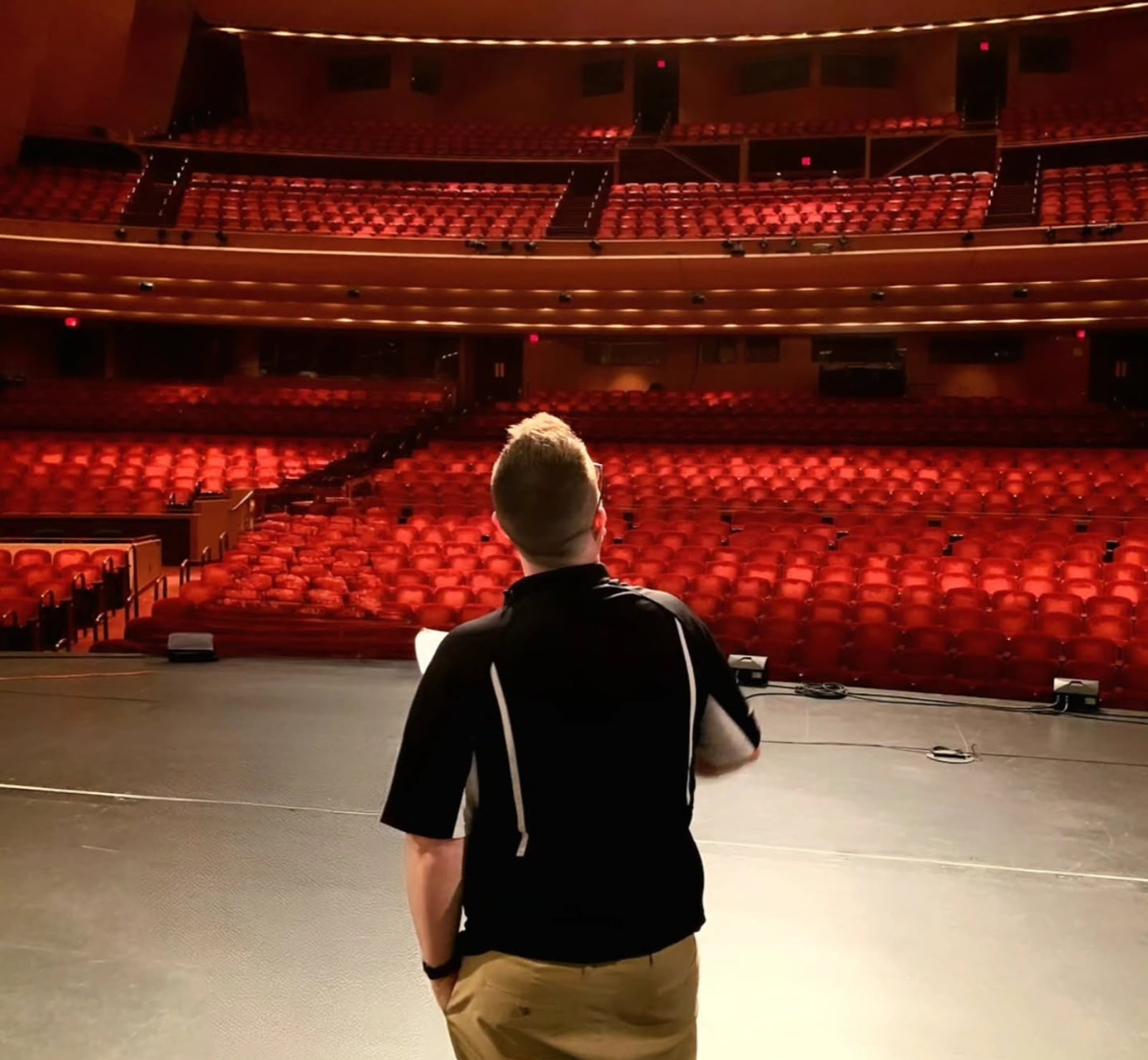
I have stood alone on a lot of stages with the work light on and every seat empty. Our stage is our world, and an empty house has never once been a judgment. It is a blank canvas. It is waiting for somebody to walk out of the wings and say the first ridiculous thing.
You are not too old. You are not too late. You are sitting in the parking lot, and the door is unlocked.
Inspiritu,
Mr. CJ